President’s Budget Blueprint: The Highs and Lows
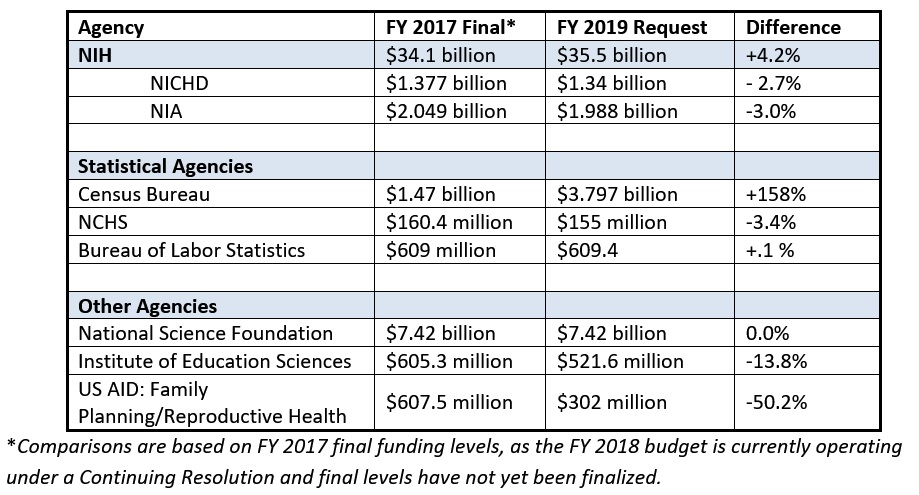
On Monday, February 12, President Trump unveiled his Fiscal Year 2019 budget blueprint and submitted it to Congress, officially kicking off the FY19 budget process. The president’s proposal is a truly mixed bag of shifting priorities that would create budgetary winners and losers—but the bottom line is that it is Congress who ultimately decides where federal dollars are allocated, and all indications are that the final FY19 budget will look significantly different than this blueprint. That said, a presidential budget submission is an important starting point. Here’s how agencies of interest to population scientists fared:
 National Institutes of Health
A highlight of the President’s plan is a significant commitment of funding to combat the opioid crisis. As part of this plan, the National Institutes of Health (NIH) would receive an infusion of $750 million in new funding. However, this investment would be offset by reductions at nearly every institute—except for a handful that pertain to mental health and drug addiction. The Administration will be releasing more detailed information in the coming weeks regarding funding levels for specific programs within NIH. Also, as part of the its budget, the Administration proposes relocating the Agency for Healthcare Quality and Research, National Institute for Occupational Safety and Health, and National Institute on Disability, Independent Living, and Rehabilitation Research to the NIH.
Census Bureau
Of its total $3.7 billion request, the President’s budget recommends allocating approximately $3.19 billion for the 2020 census in FY 2019—a level about $262 million below where Commerce Secretary Wilbur Ross had previously indicated funding was needed. FY 2019 is a crucial year for census 2020 preparations, including opening all area census offices, fully launching the Partnership Program, and refining all IT systems; thus, census stakeholder organizations will be urging Congress to support more funding for the Census Bureau than the President’s proposed budget recommends. In terms of Current Surveys and Programs (CSP), which funds ongoing demographic and economic surveys, the president requested $249 million, which represents a reduction of over $20 million from FY 2017 levels.
National Center for Health Statistics
Under President Trump’s proposed budget, the National Center for Health Statistics (NCHS) is slated to receive $155 million in FY 2019, approximately $5 million less the agency received in FY 2017. Since 2011, NCHS has been flat funded, compelling the agency to make incremental annual spending cuts. These cuts have adversely affected staffing levels, survey sample sizes, and the ability of the agency to implement necessary technological innovations. The FY 2019 budget proposal, if enacted, could force NCHS to pursue further reductions, including possibly discontinuing one of its major health surveys.
Bureau of Labor Statistics
The President’s budget calls for essentially level funding for the Bureau of Labor Statistics (BLS) at a level of $609.4 million in FY 2019. This is a less than 0.1% increase over the final enacted FY 2017 level. This comes on the heels of several years of stagnant funding that has stretched the BLS to the limits of its capacity to maintain quality of all currently existing surveys. Continued budgetary stagnation calls into question the possibility of unpalatable programmatic cuts.
Institute of Education Sciences
The Institute of Education Sciences (IES), which funds research grants as well as the National Center for Education Statistics (NCES), received an allocation of $522 million, which would represent a cut of about $84 million compared to the FY 2017 enacted level—or a 14 percent cut.
National Science Foundation
The President requested an overall level of $7.42 billion for the National Science Foundation (NSF), which is the same amount that was appropriated in FY 2017. However, under his FY 2019 plan, the Research and Related Activities (RRA) account would receive a boost of $145 million, or about 2 percent. This is accomplished by reducing line items for Major Research Facilities and the overall management accounts. As with several other agencies, the NSF will be releasing more detailed information in the coming weeks concerning allocations among directorates and major initiatives.
US Agency for International Development: Reproductive Health/Family Planning Account
The President’s request includes a veritable “hatchet job” to the Global Health Accounts at USAID, including slashing support for the Family Planning/Reproductive Health Account (FP/RH) by almost 50 percent in FY 2019 as compared to FY 2017. It is unclear how much of a cut the Demographic and Health Surveys (DHS), which is indirectly supported via funding from the FP/RH account, would sustain if the President’s allocation were to be enacted. The DHS program receives a significant amount of funding from partners outside of USAID and thus presumably would not be quite as severely affected as other programs.
Other highlights
In an addendum accompanying the budget, the Administration includes two notable sections:
- This section addresses recommendations issued by the Commission on Evidence-Based Policymaking and states Administration’s intention to work with Congress “to advance evidence-based policy making.”
- This section discusses contributions of federal statistical agencies.
On March 19 and 20, select officials representing the Population Association of America and Association of Population Centers will be on Capitol Hill to inform policymakers about the population sciences and to encourage strong investments in federal agencies that directly and indirectly support the field.
#latest-news#GPAC2018#FederalFunding